THE DEAD LETTERS SERIES
A seven-book noir thriller series following Émilie Vidal as she uncovers corruption networks that connect the most powerful people in Paris. Each book stands alone, but together they reveal something larger—a web of protection that spans decades.

BOOK ONE
THE PAPER TRAIL
Three missing women. Three cold cases. One pattern no one wanted found.
THE STORY
Émilie Vidal left war reporting behind for a quiet job in the Paris police archives. No more Kabul dust, no more Damascus rubble—just file folders and silence.
Then she finds the pattern.
Three missing women across three cities, decades apart. Each investigation went cold. Each file showed the same warning signs. And each case pointed to the same man—someone powerful enough that evidence disappeared, witnesses went silent, and investigators got transferred.
With Detective Lieutenant Alain Masson reluctantly at her side, Émilie follows a trail through Lyon, Bordeaux, and Paris. Every answer raises new questions. Every file reveals another layer of protection. And someone is watching—someone who’s kept these secrets buried for thirty years.
Because some crimes don’t end when the file closes. They end when someone finally refuses to look away.
WHAT TO EXPECT
- Gritty Parisian noir with institutional corruption at its core
- A protagonist haunted by her years covering war zones
- Complex mystery rooted in realistic power networks
- Atmospheric investigation across Paris’s hidden spaces
- Sharp dialogue and relentless pacing
FOR READERS WHO LIKE
- Investigative journalism thrillers
- Corruption mysteries with institutional depth
- Character-driven noir
- European crime fiction (Lucarelli, Mankell, Camilleri)
- Flawed protagonists with haunted pasts
Also available in Italian (Lettere Morte: Il Filo di Carta) and French (Lettres Mortes : Le Fil de Papier)

BOOK TWO
THE DAMASCUS FILE
Three years of guilt. A sister who faked her death. And the pharmaceutical conspiracy that killed twelve people to keep one journalist silent.
THE STORY
Émilie Vidal has carried Damascus for three years like a stone. Twelve people dead in a safehouse raid—activists, journalists, medical volunteers—all because her article exposed their location. Or so she believed.
Then a photograph arrives from Beirut. A Damascus street corner, time-stamped three months before the raid, and Sophie’s handwriting on the back: You were wrong about what happened. Find me if you want the truth.
Sophie. Her sister. Dead for three years. Beaten outside her Marseille apartment while investigating pharmaceutical corruption, dead from complications after surgery. Émilie couldn’t even make it back from Syria in time to say goodbye.
Except Sophie isn’t dead.
Following the trail from Beirut to Paris to Marseille, Émilie uncovers the investigation that nearly killed Sophie: Vacheron Santé, a French pharmaceutical giant testing unauthorized drugs on Syrian refugees. When Sophie got too close to the truth, her own editor at Agence Nouvelle sold her location to protect advertising revenue. The Damascus raid wasn’t journalism taking risks—it was contract killing disguised as intelligence work.
Now Sophie’s surfaced, and the people who tried to kill her three years ago know she’s alive. With Alain Masson pulled into a case that spans two countries and threatens both sisters, Émilie faces the conspiracy that destroyed twelve lives, silenced witnesses, and let her carry guilt that was never hers to carry.
Because some investigations don’t end when you bury the journalist. They end when that journalist comes back from the dead.
WHAT TO EXPECT
- Pharmaceutical corruption meets Syrian war zone reality
- Family bonds fractured by three years of deception
- Corporate conspiracy rooted in refugee exploitation
- Dual timelines: Paris/Marseille present, Damascus/Beirut past
- Higher stakes, darker betrayals than Book One
FOR READERS WHO LIKE
- Medical thrillers with institutional corruption
- Stories exploring war zone exploitation
- Sibling relationships tested by impossible choices
- Investigative journalism against corporations that kill
- Character-driven noir with international scope
Also available in Italian (Lettere Morte: Il Dossier di Damasco) and French (Lettres Mortes : Le Dossier de Damas)

BOOK THREE
THE MARSEILLE ACCOUNT
A widow’s suspicion. A dead executive’s hidden files. And a banking network that kills to stay hidden.
THE STORY
The café in Marseille was supposed to be Émilie’s refuge. A place where she and Masson could finally build something that didn’t involve corruption networks and dead witnesses.
Then Catherine Mercier walks in with a folder full of evidence.
Her husband Laurent worked for Vacheron Santé—the pharmaceutical company Sophie exposed six months ago. But Laurent wasn’t just documenting illegal drug trials. He was tracking something deeper: the money-laundering infrastructure moving dirty cash through Marseille’s shipping companies, Cyprus shell corporations, and respectable banking channels. Three days before his “suicide,” he mentioned Sophie’s name. He said if anything happened to him, Catherine should find Émilie.
Now Catherine has the files. Émilie has questions. And Sophie emerges from the shadows with three years of covert intelligence about the same network. As they work parallel investigations, Masson uncovers a pattern: executives who get too close to the truth die in apparent suicides. Banking officials who ask questions have fatal accidents. The protection doesn’t come from organized crime—it comes from legitimate business protecting its darkest operations.
The Marseille Account isn’t just a ledger. It’s the financial spine connecting every corrupt enterprise they’ve been fighting. And someone has been killing witnesses to protect it for years.
WHAT TO EXPECT
- Sisters working together—but clashing over methods and ethics
- Banking corruption hidden behind legitimate business façades
- Investigation spanning Marseille’s maritime commerce and financial networks
- Masson torn between official duties and the truth Émilie is uncovering
- Sharp noir atmosphere with Mediterranean corruption at its core
FOR READERS WHO LIKE
- Financial thrillers with institutional corruption
- Sibling dynamics under pressure
- Multi-layered investigations connecting past crimes to present danger
- European crime fiction rooted in realistic power structures
- Protagonists who refuse to stop digging even when it’s safer to walk away
Also available in Italian (Lettere Morte: Il Conto di Marsiglia) and French (Lettres Mortes : Le Compte de Marseille)

BOOK FOUR
THE MEMORY VAULT
Seventeen archivists. All dead. And the mentor who taught Émilie how to read silence has just become the eighteenth.
THE STORY
Three days after the Marseille investigation closes, an anonymous envelope arrives at the café. Inside: a list of seventeen names, each followed by a date and a location. Records clerks. Evidence managers. Junior detectives buried in basement filing rooms. The invisible infrastructure of institutional memory, eliminated one by one over twenty-five years.
At the bottom of the page, handwritten: They died protecting what they found.
Henri Laplace, who spent thirty-one years as chief archivist at the Paris Police Prefecture, was fed into an industrial shredder and ruled an accident. He was Émilie’s mentor—the man who taught her that archives aren’t dead storage, they’re the memory of everything institutions want to forget. Three days before he died, he’d found documentation linking current officials to their fathers’ and grandfathers’ crimes. Senators. Ministers. Prefects. Families that have held power in France for sixty years.
This isn’t a single predator, like Valentin. It isn’t a pharmaceutical company, like Vacheron Santé. It’s something older and more deeply embedded—political dynasties protecting inherited corruption across three generations, with allies inside the judiciary, the Interior Ministry, and the National Assembly itself.
As Masson works the official investigation under mounting departmental pressure, and Sophie operates a parallel thread from inside the intelligence world, Émilie follows the dead archivists’ trail toward what they spent their careers assembling in secret: a shadow archive. Evidence gathered piece by piece by people who knew they were being hunted, and who left it behind anyway.
Seventeen people died so that someone, someday, would find it. Émilie intends to make sure it wasn’t for nothing.
WHAT TO EXPECT
- The deepest and oldest layer of the series’ corruption network — political dynasties, not just corporate players
- Émilie’s years in the archives brought to the foreground, with Henri Laplace as the emotional core
- Masson under pressure from within a department that doesn’t want this investigated
- Sophie operating between intelligence work and personal loyalty
- Slower burn, higher stakes — an investigation into what institutions are willing to destroy to stay protected
FOR READERS WHO LIKE
- Political conspiracy thrillers with historical depth
- Institutional corruption spanning multiple generations
- Investigative noir with a strong emotional anchor
- Cold case patterns connecting past crimes to present danger
- European crime fiction where the system is both the suspect and the obstacle
Also available in Italian (Lettere Morte: La Cripta della Memoria). French edition coming soon.
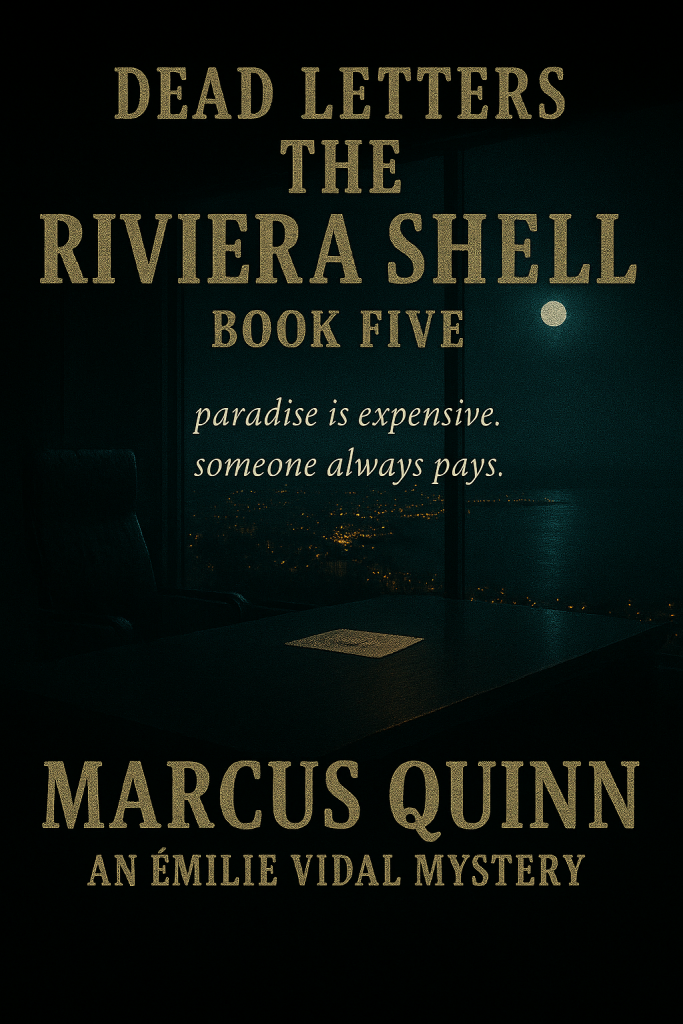
BOOK FIVE
THE RIVIERA SHELL
The French Riviera runs on money that doesn’t want to be found. Émilie Vidal is about to find it.
THE STORY
An anonymous letter leads her to a hilltop cemetery above Nice and a dead accountant’s grave. Hidden beneath the headstone for twenty-seven years: ledger pages written in a civil servant’s precise hand. Dates. Entities. Amounts. The careful notation of a man who knew what he’d discovered would outlive him—because someone would eventually come looking.
The ledgers point to a network of shell companies and property transfers spanning five decades along the Côte d’Azur. But decoding them requires expertise Émilie doesn’t have, and the people who do have it come with agendas of their own. A forensic accountant fired for asking the wrong questions. A retired commissaire whose career was built on knowing which investigations to close. Allies who may not be allies at all.
Masson is working the same case from the other side—a police investigation running parallel to Émilie’s journalism, their timelines structurally incompatible. The evidence has an expiration date. Trust is not the issue. Timing is.
The deeper Émilie digs, the clearer it becomes: the Riviera’s corruption is not an aberration. It’s architecture. Maintained by law. Protected by silence. Sustained by people who benefit from not asking questions.
Émilie asked the questions. Now she has to survive what the answers set in motion.
A noir thriller of shell companies, forensic accounting, and institutional corruption along the French Riviera. Book Five in the Dead Letters series. Each investigation stands alone. The network runs deeper than the evidence can reach.
WHAT TO EXPECT
- The financial machinery behind the corruption network exposed in earlier investigations
- Growing tension between Émilie, Masson, and Sophie over priorities and values
- Masson reluctantly investigating internal police corruption
- Sophie operating between intelligence work and personal loyalty
- Questionable alliances and surprising criminal conspiracies
FOR READERS WHO LIKE
- Political conspiracy thrillers with historical depth
- Money-laundering schemes spanning shell companies and borders
- Investigative noir with a strong emotional anchor
- Cold case patterns connecting past crimes to present danger
- European crime fiction where the system is both the suspect and the obstacle
Also available in Italian (Lettere Morte: La Società di Comodo). French edition coming soon.

BOOK SIX
THE HIPPOCRATIC FILES
A regional journalist’s “suicide.” A private hospital with a body count. And a sister who resurfaces with a secret that will nearly cost her life.
THE STORY
Lyon in January is colder than Émilie remembers, and it’s waiting for her with four words on a burner phone: The Hippocratic files. Lyon.
The trail leads to Nadia Ferraris, a regional reporter found dead — ruled a suicide — who had spent eighteen months investigating a cluster of suspicious deaths at Clinique Saint-Julien. What Nadia found went deeper than malpractice: unnecessary surgeries, suppressed side effects from unauthorized drug trials, and a false-billing scheme funneling money through a chain of intermediaries into a much larger financial architecture. The local press, meanwhile, has been bought into silence one advertising contract at a time — and Émilie is forced to confront how her own profession has enabled every corruption network she’s ever exposed.
Sophie resurfaces mid-investigation, working the same case from the financial side. Their partnership is careful, professional, and the first real reconciliation in years — a working truce built on results instead of trust. Masson, newly vindicated and running a multi-jurisdictional task force, provides official cover from the outside while staying deliberately blind to what Sophie is doing off the books.
The exposé Émilie publishes is effective enough that the network notices. Then Sophie is attacked in her own safe house — and survives, barely. As she’s rushed to hospital, Émilie realizes the anonymous tip that started everything came from somewhere far closer to Sophie’s own operation than either of them ever suspected.
WHAT TO EXPECT
- Medical fraud and media complicity as two faces of the same silence
- Émilie forced to reckon with journalism’s own role in the protection racket
- A cautious, hard-won working partnership between the Vidal sisters
- Masson’s authority tested at the very moment of his vindication
- A gut-punch ending that reopens the question of who can be trusted
FOR READERS WHO LIKE
- Medical and pharmaceutical corruption thrillers
- Investigative journalism turned inward on itself
- Sibling partnerships built on hard-earned trust, not sentiment
- European noir with institutional rot at every level
- Endings that raise the stakes instead of resolving them
Also available in Italian (Lettere Morte: I Fascicoli Ippocratici). French edition coming soon.

BOOK SEVEN
THE CONFESSION BOX
A sister in a coma. Eleven hours of confession from a dying man with nothing left to protect. And a name at the center of it all that Émilie has been circling since the Paris archives of Book One.
THE STORY
Sophie survives the attack, but only barely — a medically induced coma, a corridor vigil, an investigation that has to run without her for three long weeks. In her place, Émilie is left holding what Sophie photographed but never had the chance to read: the Confession Box, the accumulated testimony of a legal “cleaner” who has spent thirty years arranging the disappearance of evidence and the protection of everyone this series has ever circled. He wants absolution before the end. What he gives Émilie instead is the architecture of everything.
Buried inside eleven hours of recordings is the answer to the question that matters more than any crime already solved: who betrayed Sophie, and why. The answer arrives slowly, earned rather than handed over, and it reaches further into the French state than Émilie — or the reader — is ready for.
Sophie recovers. The reunion between the sisters is quiet and unsentimental, carrying the weight of six books of a fractured relationship without needing to say so. Together, they finish what the confession started. Masson builds the case from the outside. And when the truth finally surfaces, it costs some people everything — and lets others walk away entirely intact.
The series that began in a Paris archive ends there too. Some secrets get published. Some get buried under classification codes instead of concrete. And Émilie, alone at a café counter with a notebook open, starts writing the first line of something new.
WHAT TO EXPECT
- The full architecture of six books’ worth of corruption finally named
- A slow-burn whodunit built entirely on the question of loyalty
- The Vidal sisters’ most functional, least sentimental partnership yet
- A resolution that is deliberately, honestly incomplete
- A full-circle ending that closes the series without closing every wound
FOR READERS WHO LIKE
- Series finales that pay off every earlier book without over-explaining
- Espionage-adjacent noir where the state itself is the final suspect
- Endings with moral cost instead of clean victory
- Character-driven mysteries built on years of accumulated relationship
- European crime fiction that trusts its reader to sit with ambiguity
Also available in Italian (Lettere Morte: Il Confessionale). French edition coming soon.
ABOUT ÉMILIE VIDAL
Émilie Vidal is a protagonist forged in war zones and broken by guilt. A former war correspondent who covered Kabul, Damascus, and Mosul, she carries the weight of every story she couldn’t save, every source she couldn’t protect. Her sister’s death destroyed her journalism career, but it sharpened her instincts for finding patterns in chaos.
She’s courageous without being fearless—her hands shake, her sleep is haunted, and she questions every choice. That vulnerability makes her perfect for noir. She doesn’t solve cases with brilliance alone. She solves them with stubbornness, survivor’s guilt, and the inability to look away from injustice even when it would be safer to stop digging.
Émilie Vidal investigates because she has to. Because silence costs more than danger. Because some stories demand to be told, no matter the price.